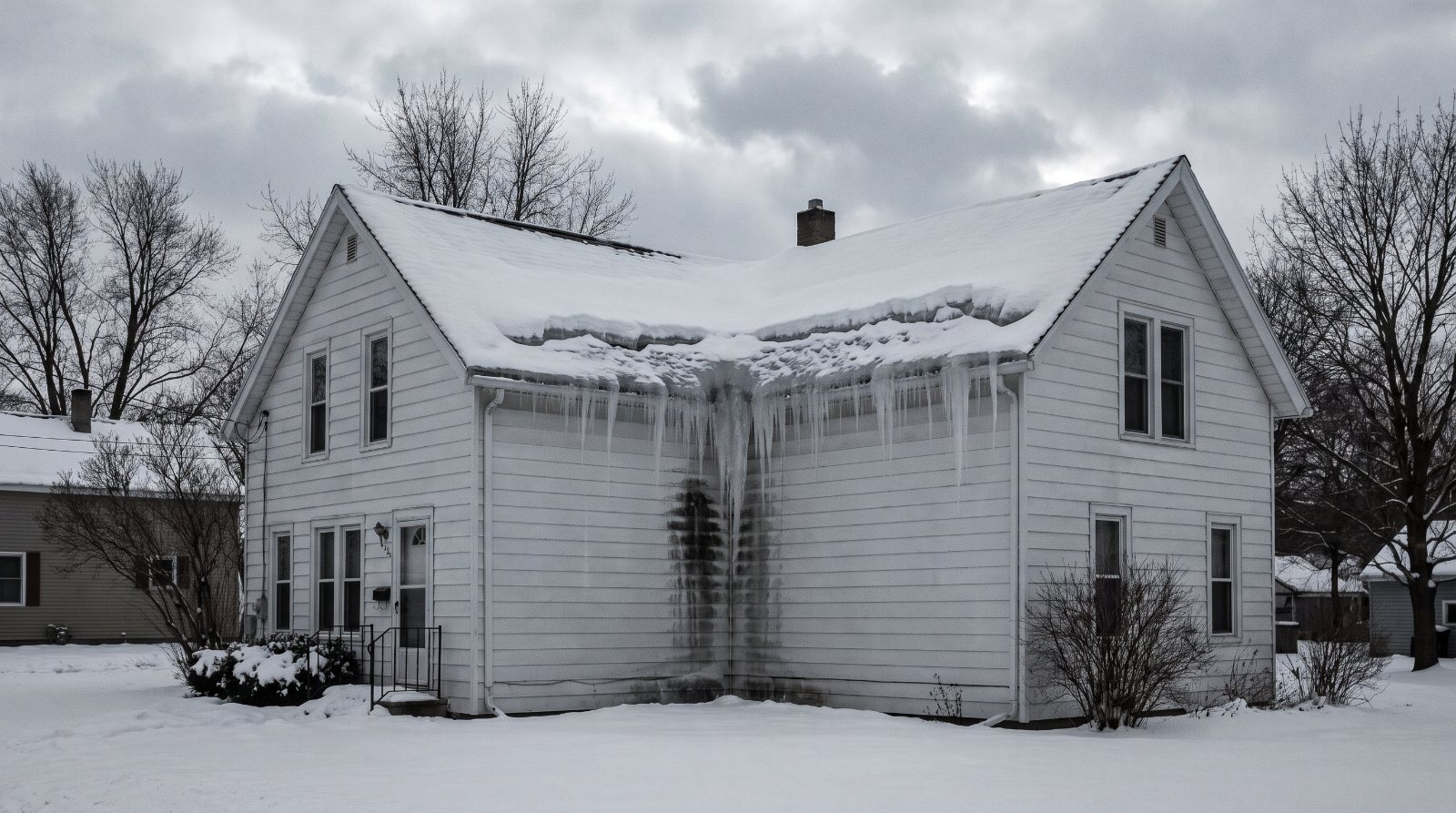
Every February we take the same call. A brown ring has appeared on an upstairs ceiling, it is not raining, and the homeowner cannot work out where the water came from. The answer is almost always the roof edge, and the damage started weeks earlier.
What is actually happening up there
An ice dam is a heat problem that looks like a roof problem. Warm air escapes from the living space into the attic, heats the underside of the roof deck, and melts the bottom layer of snow sitting on top of it. That meltwater runs down the slope until it reaches the eave — which overhangs unheated space and stays at outside temperature — and refreezes there.
Do that for a few days and the refrozen ice builds a ridge along the eave. Now every subsequent melt cycle runs down and hits that ridge, backs up behind it, and pools. Asphalt shingles are designed to shed water running downhill; they are not designed to hold standing water. Once it is deep enough, it works under the shingle courses, through the nail penetrations, and into the roof deck.
From there it follows the framing. This is why the stain rarely appears directly under the leak — water can travel several feet along a rafter or a top plate before it finds a path through the ceiling drywall. It is also why the visible stain is a poor guide to the size of the wet area.
Water enters during the melt, then everything refreezes and it stops. The stain only appears once it has worked through the ceiling assembly, which can take a week or more. By the time you see it, insulation has been wet for a while and mold has had the conditions it needs.
Why Erie gets it worse than most places
The four fixes, in the order they actually matter
Why we usually talk people out of heat cables
Heat cables zig-zagging along the eave are the most common thing homeowners buy, and they are the last thing we recommend. They do not stop the dam forming — they melt a channel through it. That helps water get off the roof, so they can reduce damage in an emergency. But they run on electricity all winter, they degrade in UV and need replacing every few years, they can void some roofing warranties, and they leave the underlying heat-loss problem completely untouched.
There is a legitimate use for them: a roof geometry that genuinely cannot be fixed by air sealing and ventilation, such as a cathedral ceiling with no attic space, or a valley where two roof planes dump onto a low eave. In those specific cases, cables are a reasonable managed compromise. Everywhere else they are an annual electricity bill in exchange for not solving the problem.
Never get on a snow-covered roof with a hammer, a hatchet, or a shovel to break up an ice dam. People are seriously injured doing this every winter in this county, and you will damage the shingles you are trying to protect. If you must do something from the ground, a roof rake pulling snow off the lower three or four feet of the roof removes the fuel for the next melt cycle. Work from the ground, and stay clear of the power drop.
What to do if it has already leaked
The insurance line to understand
Pennsylvania carriers generally treat the interior water damage from an ice dam as a covered sudden loss, and treat the underlying cause as maintenance. So the drywall, insulation, paint and flooring are usually in scope; the air sealing and attic work that stops it happening again usually are not.
That distinction is decided by the documented cause of loss, which is why the photos and readings taken before anything is opened up matter more than anything you say to the adjuster afterwards. If you want more on how that process works, our guide to restoration claims in Pennsylvania covers it in detail.
The short version
Snow and ice roof clearing
Air sealing and insulation are the permanent fix, and neither one helps you in the middle of a February thaw with eighteen inches on the roof and ice building at the eave. That is what this service is for. We take the snow load off the lower roof and open the drainage path before meltwater finds a way into the assembly.
Clearing from the ground with roof rakes and, where the pitch requires it, steam rather than chipping. Steam melts ice without cutting into shingles or flashing. We do not send anyone onto a snow-covered roof with a hammer, and neither should you.
Snow load removal
The lower three to six feet of roof raked clear from the ground, plus valleys where drifting concentrates the weight.
Steam ice removal
Dams and gutter ice melted out with low-pressure steam so water drains instead of backing up under the shingles.
Moisture check inside
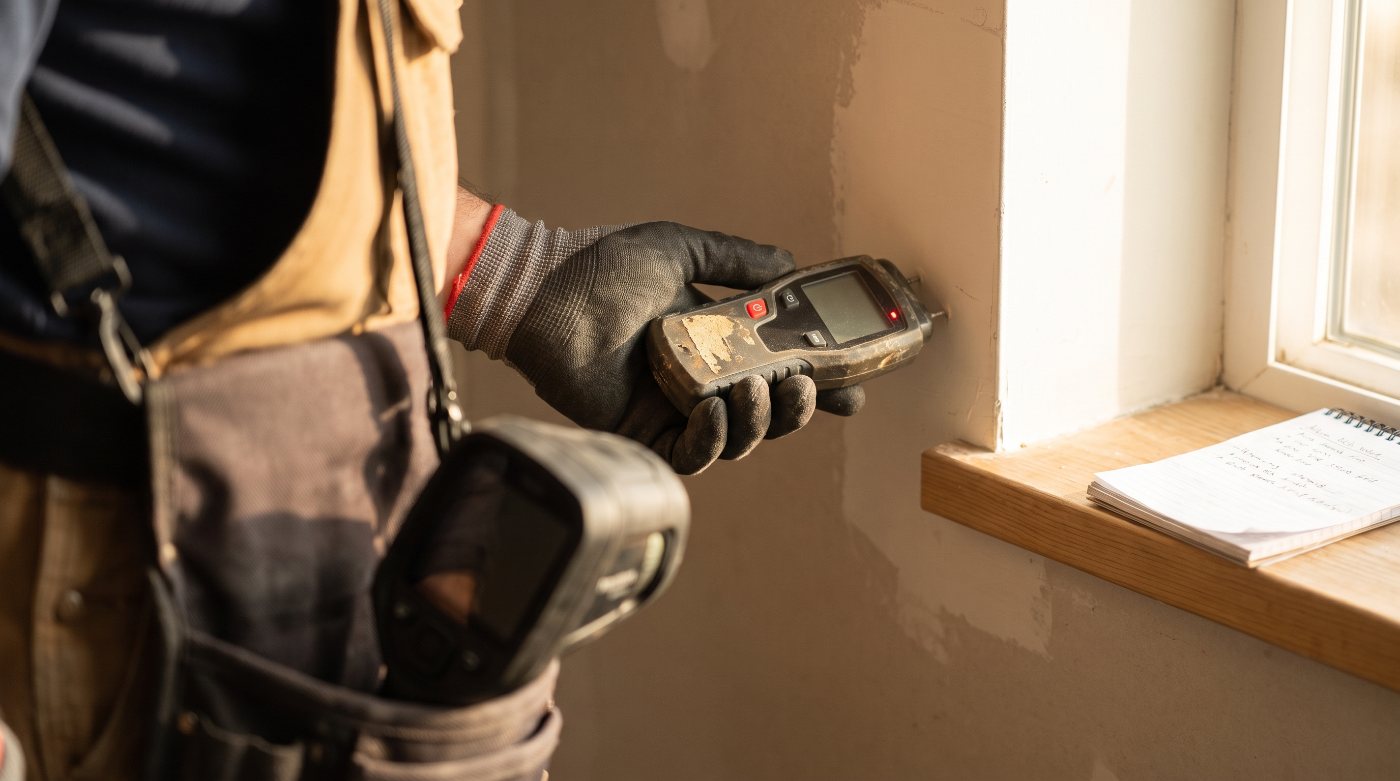
While we are there, meter readings at the ceilings and top plates below the dam. If water already got in, you find out now, not in April when it smells.
Clearing a roof costs a fraction of drying a ceiling, replacing insulation, and remediating the mold that follows. If you have had a dam once, the same eave will do it again every winter until the attic is fixed.
Get your roof cleared
Same-week scheduling through the winter, and same-day when water is already coming through.
Ceiling stain after a snow?
Water has usually been in the assembly longer than it looks. An on-site assessment tells you how far it went.