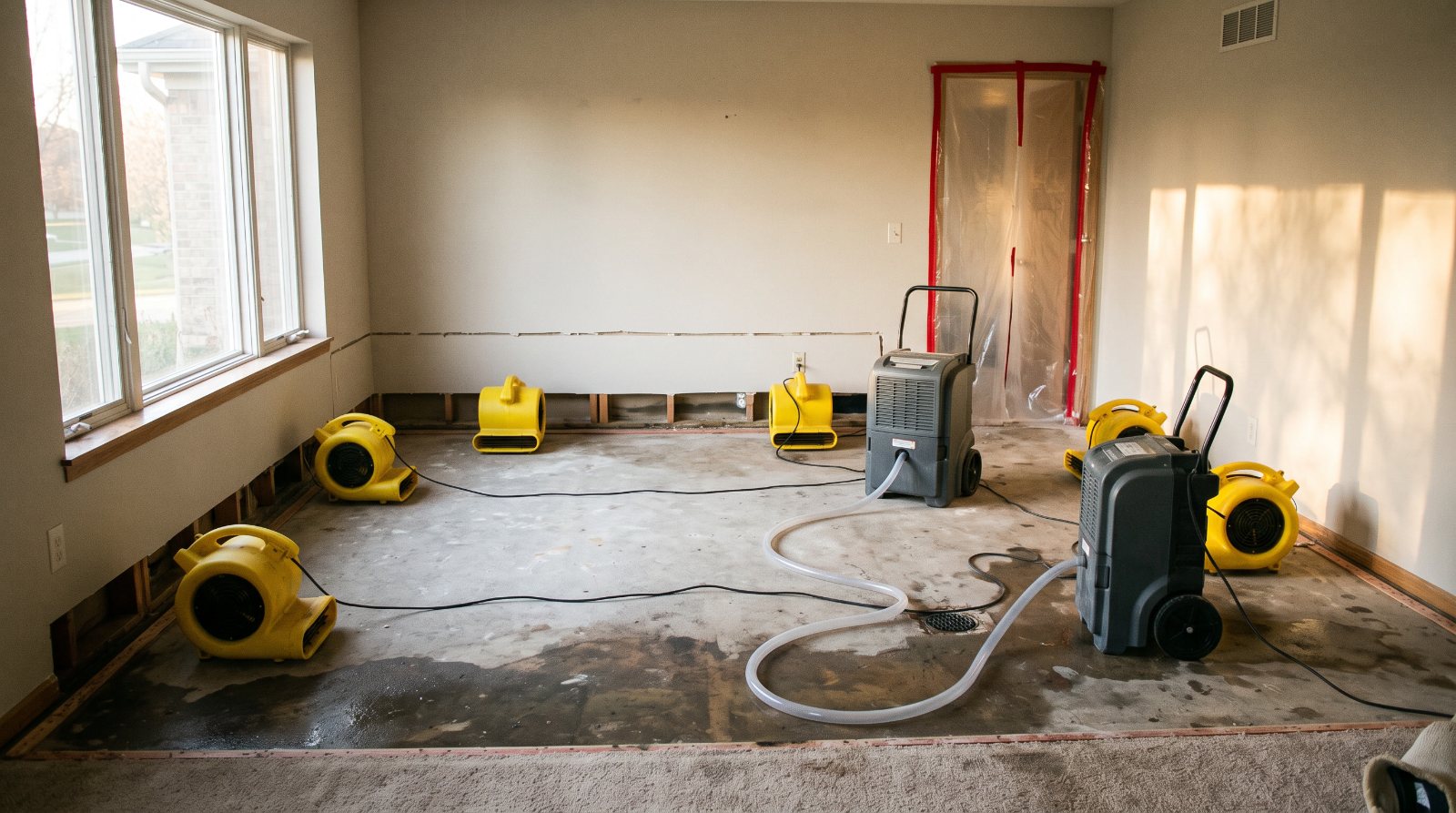
Commercial air movers and dehumidifiers drying a room

When a wet-vac is enough, and when it is not

SHIELD RESTORATION · ERIE, PA5 MIN READIICRC CERTIFIED FIRM #70248702

Restoration companies have an obvious incentive to tell you every spill is an emergency. It is not. Here is where we actually draw the line, including the cases where we tell people to hang up and get a mop.

Handle it yourself when all of these are true

The water is clean — supply line, a tipped fish tank, an overflowing sink. Not sewage, not a washing machine drain, not anything that came in from outside.
You found it within an hour or so. Time is the variable that matters most.
It stayed on a hard, non-porous surface — tile, sealed concrete, vinyl plank, finished hardwood you got to immediately.
It did not reach carpet, carpet pad, drywall, baseboard, insulation, or a subfloor seam.
It did not go through a floor into the space below.
The total area is small — a bathroom floor, a kitchen corner. Not a room.

In that situation: wet-vac or towels, get it up, pull the room open, run fans and a household dehumidifier, and check back in twenty-four hours. If a baseboard has darkened or a wall feels cool and damp at the bottom, the water went further than you thought and the calculation changes.

Call somebody when any of these are true

01
It is not clean waterSewage, a drain or lateral backup, a washing machine discharge, water that came in from outside, or anything from a toilet beyond the bowl. That is contaminated water. It carries bacteria and viruses, and porous material it touched has to be removed rather than dried — this is not a cleaning problem, it is a decontamination problem.
02
It sat overnightTwenty-four to forty-eight hours is when microbial growth begins on wet organic material. Past that window you are not drying a spill, you are managing a mold risk, and the difference matters for both the work and the insurance claim.
03
It reached carpet pad, drywall or insulationThose hold water and will not release it to a household fan. Carpet pad is a sponge; drywall wicks upward several inches; fibreglass insulation inside a wall cavity stays wet for weeks. Surface dry means nothing here.
04
It came through a ceilingWater in a ceiling assembly has passed through insulation and is sitting on the drywall from above. You cannot assess or dry that from the room below, and the wet area is reliably larger than the stain.
05
It is a finished basement or a large areaMore than a room, or any finished lower level, needs extraction volume and dehumidification capacity that rental equipment does not have.
06
You are filing an insurance claimEven on a smaller loss, documented mitigation by a certified contractor is what keeps a claim clean. A carrier can question whether damage was worsened by inadequate self-remediation.

Why box fans are not drying equipment

This is the most common misunderstanding we run into, and it is worth being precise about. A fan moves air. Moving air speeds evaporation, which lifts water out of materials and into the air in the room. That is genuinely half the job.

The other half is removing that moisture from the air, and a fan does not do it. Without dehumidification you are transferring water from the floor into the atmosphere of your house, where it condenses on cooler surfaces — inside wall cavities, behind furniture, in the closet on the north wall. People do this successfully for two days, declare the floor dry, and call us three weeks later about a smell.

What commercial equipment actually differs on

A restoration-grade dehumidifier pulls a large volume of water out of the air per day and keeps working at low humidity, which is when the last and most important part of drying happens. Air movers are designed to push a high-velocity sheet of air across a surface rather than stir a room. And the meters are the real difference: they tell you when the structure has reached dry standard instead of when it feels dry.

The hardwood floor question

We get asked this constantly and the answer is genuinely time-dependent. Solid hardwood that got wet and was extracted within a few hours can very often be saved with specialty floor drying mats, which pull moisture up through the boards. Cupping — the edges rising higher than the centres — frequently relaxes as the wood equalises over a few weeks.

Once boards have crowned, separated at the seams, or the finish has blistered, replacement is the honest answer. Engineered and laminate flooring is less forgiving: the core layers delaminate and it does not come back. If someone tells you they can save swollen laminate, be sceptical.

THE ONE THING NOT TO DO

Do not run your HVAC system to "help dry it out" after a significant water loss, and especially not after a sewage event. You will move moisture and, in a contaminated loss, contamination into every room the ductwork serves. Turn it off and open windows if the weather allows.

A rough decision test

Clean water, under an hour, hard surface onlyHandle it yourself. Wet-vac, fans, check in 24 hours.
Clean water, reached carpet or drywallCall. The pad and the wall cavity are the problem, not the floor.
Any water, sat overnightCall. Mold risk changes the whole scope.
Any contaminated water, any sizeCall. Do not mop it — that spreads it.
Came through a ceilingCall. You cannot see or dry the wet part.
Filing an insurance claimCall. Documented mitigation protects the claim.

And if you genuinely are not sure, describe it on the phone. Our assessment is free and there is no obligation, so the worst case is that we tell you it is a wet-vac job and you get on with your evening.

Not sure which one you have?

Describe it on the phone. If it is a wet-vac job we will tell you that, at no charge.

24/7 · LIVE DISPATCHER (814) 480-9422

Keep reading

SPRING

Why your sump pump will fail during the thaw

MOLD

Why the musty smell keeps coming back

SERVICE

Water damage restoration in Erie