A closed storefront is the real cost
For a retail or office tenant, the restoration invoice is rarely the biggest number. The lost trading days are. A boutique on State Street that closes for three weeks in December does not recover that revenue in January, and a professional office that cannot see clients is paying rent and salaries against nothing.
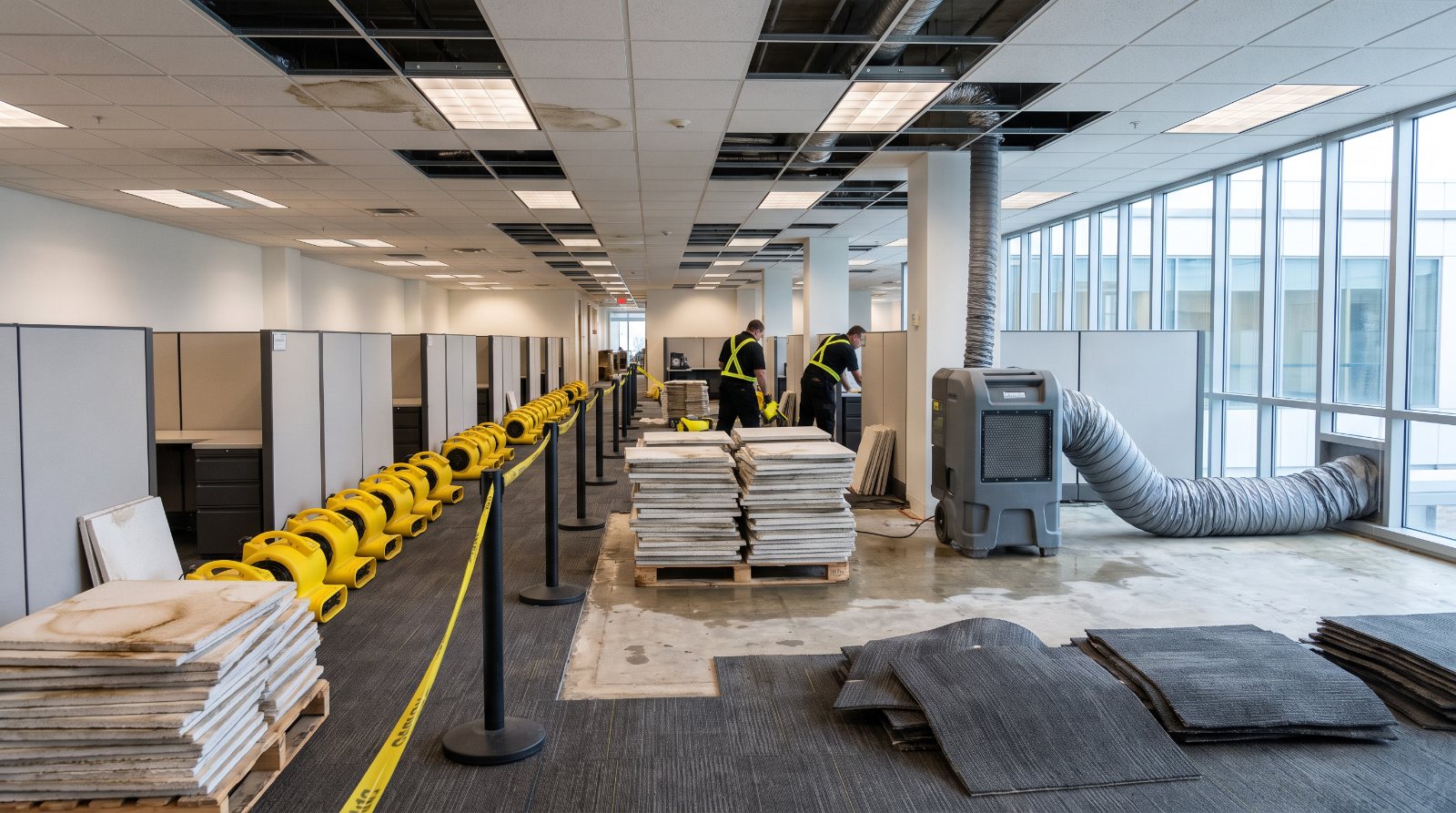
That shapes how we sequence the work. Where it is safe, we contain the damaged area with sealed barriers and negative air, run the drying inside that envelope, and leave the rest of the floor operating. Customers walk past a wall, not through a job site.
Strip centers and multi-tenant buildings add a second problem: a supply line that fails in one unit crosses into the units either side through the shared slab, the demising wall, and the common ceiling. The tenant who called us is often not the only tenant with damage, and the sooner the neighbours are metered the smaller everyone’s claim is.
Inventory and equipment are handled as a separate track from the structure. Stock, fixtures, point-of-sale systems, and paper records get pulled, documented, and either cleaned off site or written off with the documentation your adjuster needs to pay it.
Most of this work happens outside trading hours. Overnight and early-morning crews are standard for occupied retail, not a premium service.
Services for this property
Before you need us
We walk your building, map the shut-offs, and put after-hours contacts and pre-agreed rates on paper. When something fails at 2am, nobody is looking for a valve.
Commercial overview →What changes on this kind of property
Keep the doors open
Sealed containment and negative air so the unaffected floor area keeps trading while drying runs.
Protect the neighbours
Metering the adjacent tenancies immediately. Shared walls and slabs move water further than the lease line.
Inventory and fixtures
Stock and equipment pulled, inventoried and documented as a separate claim track from the building.
Out-of-hours work
Overnight and pre-open crews as standard, so the work happens when the customers are not there.
Questions
Can we stay open while you work?
Usually part of the space can. We contain the affected area, run negative air so nothing migrates, and keep the rest of the floor trading. On a small unit with a large loss that is not always possible, and we will tell you straight rather than promising it.
Who pays — us or the landlord?
It depends on your lease and both policies. The structure is normally the landlord’s building policy; your fixtures, stock and business interruption are normally yours. We document the loss so both claims can be settled from the same record instead of arguing over one set of photos.
Do you handle business interruption documentation?
We provide the loss documentation, drying logs and scope that a business interruption claim is built on. The claim itself is between you and your carrier, but the evidence comes from us and we make sure it is complete.