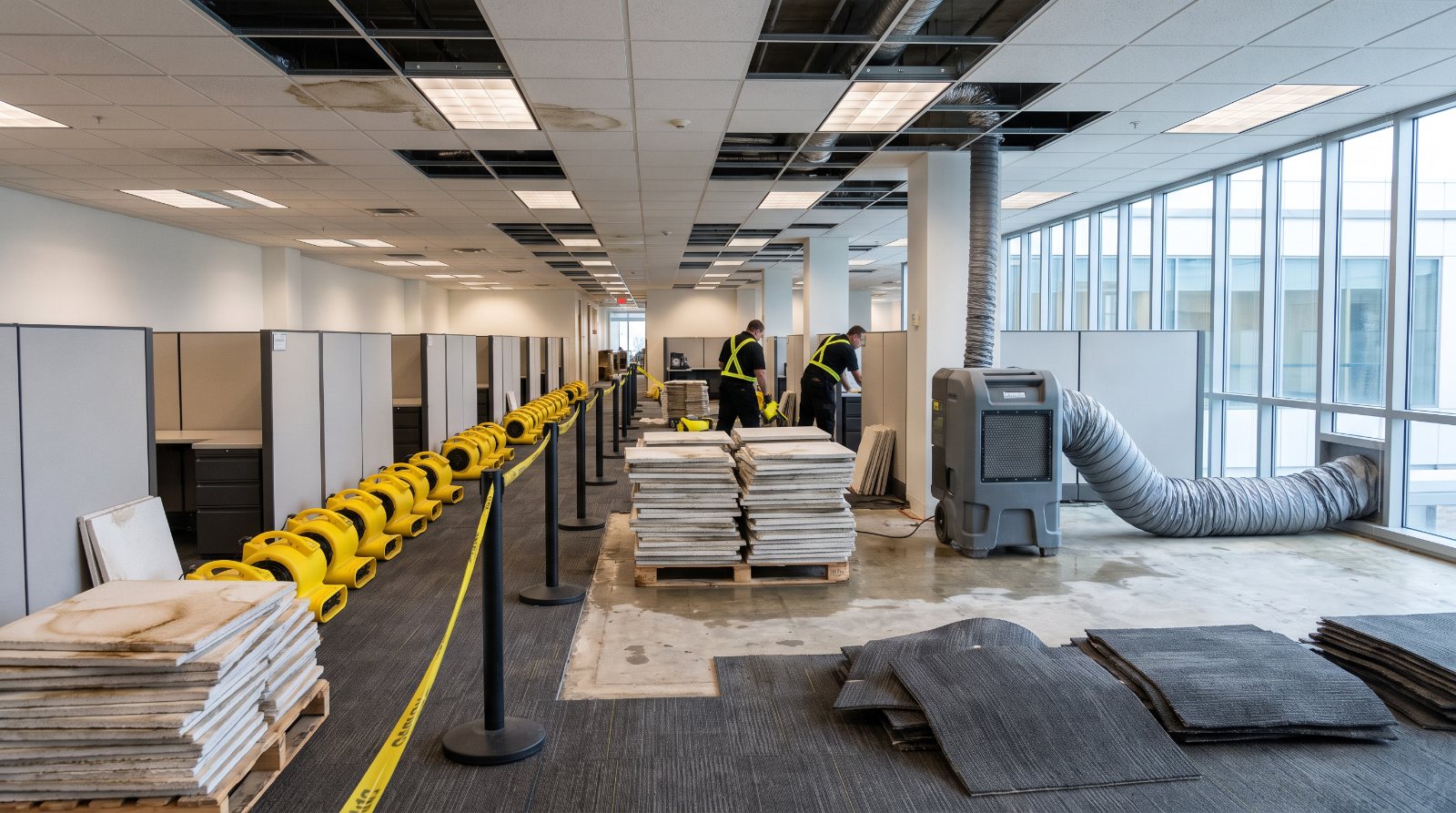
Large buildings that sit empty half the week
Schools and churches share a pattern that makes losses worse: large buildings, thin weekday supervision, and long stretches with nobody in them. A supply line that fails Friday evening in a church is found Sunday morning. A pipe that splits over winter break in a school is found in January.
Both also tend to be old. Erie County has a lot of mid-century school buildings and considerably older churches, which means plaster, terrazzo, masonry, wood floors, and pipe runs through unheated crawl spaces and bell towers. Old buildings hold water in places new ones do not.
Scheduling is the whole game. Summer, winter break and spring break are when substantial work gets done, and we plan multi-phase scopes around an academic calendar rather than a construction one. For churches it is the week rather than the term: work happens Monday to Friday and the sanctuary is ready for the weekend.
Occupied-school work carries the same constraints as healthcare, for the same reason. Containment, negative air, no unsecured openings, and crews who are background-checked and badged where the district requires it.
Historic and irreplaceable elements need a different approach from a commercial fit-out. Pipe organs, stained glass, pews, plaster detail, and archives are stabilised and specialist-referred rather than treated as replaceable finishes.
Services for this property
Before you need us
We walk your building, map the shut-offs, and put after-hours contacts and pre-agreed rates on paper. When something fails at 2am, nobody is looking for a valve.
Commercial overview →What changes on this kind of property
Break and summer phasing
Multi-phase scopes planned around the academic calendar, with the building handed back on schedule.
Monday to Friday for churches
Work sequenced so the sanctuary is ready for the weekend, not mid-demolition on a Sunday morning.
Containment and access control
Sealed work zones, secured openings, and crews badged and checked where the district requires it.
Irreplaceable elements
Organs, stained glass, plaster detail and archives stabilised and referred to specialists rather than replaced.
Questions
Can the work be done over summer break?
That is usually the right answer for a school. We scope it in spring, phase it across the break, and hand the building back before staff return. Emergency mitigation obviously does not wait for a calendar.
We found water on a Monday morning. How fast can you be here?
Same as any emergency — a live dispatcher and a crew rolling. For a school that has been closed since Friday, the priority is finding out how far it went before anyone occupies the space.
Our building has historic elements. Will they survive?
Some will and some will not, and you deserve an honest assessment rather than an optimistic one. We stabilise first, then bring in the right specialist for organs, glass or plasterwork. What we will not do is treat a hundred-year-old interior as a commercial finish.